Header Logo

Search Result Details

This page shows the details of why an item matched the keywords from your search.
One or more keywords matched the following properties of Ambros, Victor
PropertyValue
overview

Biography

Victor Ambros grew up in Vermont and graduated from MIT in 1975. He did his graduate research (1976-1979) with David Baltimore at MIT, studying poliovirus genome structure and replication. He began to study the genetic pathways controlling developmental timing in the nematode C. elegans as a postdoc in H. Robert Horvitz's lab at MIT, and continued those studies while on the faculty of Harvard (1984-1992), Dartmouth (1992-2007), and the University of Massachusetts Medical School (2008-present). In 1993, members of the Ambros lab identified the first microRNA, the product of lin-4, a heterochronic gene of C. elegans. Since then, the role of microRNAs in development has been a major focus of his research.

Silverman Professor of Natural Sciences, Professor, Program in Molecular Medicine

Ambros Lab Web Page


Molecular and genetic control of animal development; microRNA regulatory mechanisms

We are interested in the genetic regulatory mechanisms that control animal development, and in particular the molecules that function during animal development to ensure the proper timing of developmental events. We have primarily employed the nematode Caenorhabditis elegans as a model system for studying the function of regulators of developmental timing, which in C. elegans are known as the “heterochronic genes”, in reference to the remarkable changes in relative timing of developmental event that are elicited by mutations in these genes. The heterochronic genes comprise a set of interrelated regulatory pathways that include proteins that regulate the transcription of other genes, and also a class of small RNA, known as microRNAs, that regulate the production of protein by the messenger RNAs of specific target genes. Much of our research in recent years has been aimed at understanding how microRNAs are integrated into broader regulatory networks related to animal development and human disease, and at uncovering the molecular mechanisms for how microRNAs exert their effects on gene expression.
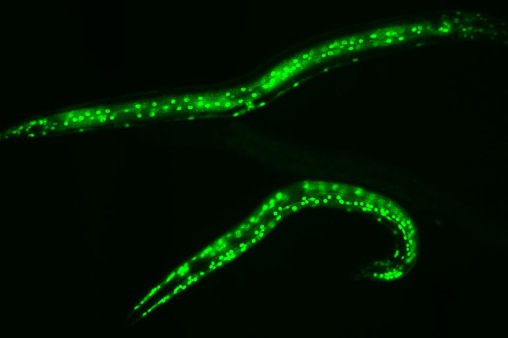
Victor's Worms

One or more keywords matched the following items that are connected to Ambros, Victor
Item TypeName
Academic Article Heterochronic genes control cell cycle progress and developmental competence of C. elegans vulva precursor cells.
Academic Article The cold shock domain protein LIN-28 controls developmental timing in C. elegans and is regulated by the lin-4 RNA.
Academic Article The timing of lin-4 RNA accumulation controls the timing of postembryonic developmental events in Caenorhabditis elegans.
Academic Article Control of developmental timing in Caenorhabditis elegans.
Academic Article The temporal control of cell cycle and cell fate in Caenorhabditis elegans.
Academic Article microRNAs: tiny regulators with great potential.
Academic Article Developmental regulation of a cyclin-dependent kinase inhibitor controls postembryonic cell cycle progression in Caenorhabditis elegans.
Academic Article MicroRNAs and other tiny endogenous RNAs in C. elegans.
Academic Article Temporal regulation of microRNA expression in Drosophila melanogaster mediated by hormonal signals and broad-Complex gene activity.
Academic Article Role of microRNAs in plant and animal development.
Academic Article Expression profiling of mammalian microRNAs uncovers a subset of brain-expressed microRNAs with possible roles in murine and human neuronal differentiation.
Academic Article The C. elegans heterochronic gene lin-46 affects developmental timing at two larval stages and encodes a relative of the scaffolding protein gephyrin.
Academic Article The functions of animal microRNAs.
Academic Article Efficient gene transfer in C.elegans: extrachromosomal maintenance and integration of transforming sequences.
Academic Article The let-7 MicroRNA family members mir-48, mir-84, and mir-241 function together to regulate developmental timing in Caenorhabditis elegans.
Academic Article Structure and function analysis of LIN-14, a temporal regulator of postembryonic developmental events in Caenorhabditis elegans.
Academic Article The Caenorhabditis elegans heterochronic regulator LIN-14 is a novel transcription factor that controls the developmental timing of transcription from the insulin/insulin-like growth factor gene ins-33 by direct DNA binding.
Academic Article Interacting endogenous and exogenous RNAi pathways in Caenorhabditis elegans.
Academic Article The lin-41 RBCC gene acts in the C. elegans heterochronic pathway between the let-7 regulatory RNA and the LIN-29 transcription factor.
Academic Article Most Caenorhabditis elegans microRNAs are individually not essential for development or viability.
Academic Article Development. Dicing up RNAs.
Academic Article Drosophila let-7 microRNA is required for remodeling of the neuromusculature during metamorphosis.
Academic Article A C. elegans genome-scale microRNA network contains composite feedback motifs with high flux capacity.
Academic Article Systematic analysis of dynamic miRNA-target interactions during C. elegans development.
Academic Article An extensive class of small RNAs in Caenorhabditis elegans.
Academic Article Molecular cloning of lin-29, a heterochronic gene required for the differentiation of hypodermal cells and the cessation of molting in C.elegans.
Academic Article The expression of the let-7 small regulatory RNA is controlled by ecdysone during metamorphosis in Drosophila melanogaster.
Academic Article MicroRNAs: genetically sensitized worms reveal new secrets.
Academic Article Molecular genetics of the Caenorhabditis elegans heterochronic gene lin-14.
Academic Article A new kind of informational suppression in the nematode Caenorhabditis elegans.
Academic Article A hierarchy of regulatory genes controls a larva-to-adult developmental switch in C. elegans.
Academic Article MicroRNA pathways in flies and worms: growth, death, fat, stress, and timing.
Academic Article The Caenorhabditis elegans heterochronic gene pathway controls stage-specific transcription of collagen genes.
Academic Article The heterochronic gene lin-29 encodes a zinc finger protein that controls a terminal differentiation event in Caenorhabditis elegans.
Academic Article Heterochronic genes and the temporal control of C. elegans development.
Academic Article Mesodermally expressed Drosophila microRNA-1 is regulated by Twist and is required in muscles during larval growth.
Academic Article Silencing of retrotransposons in Dictyostelium by DNA methylation and RNAi.
Academic Article Developmental biology. Encountering microRNAs in cell fate signaling.
Academic Article Characterization of microRNA expression levels and their biological correlates in human cancer cell lines.
Academic Article The regulation of genes and genomes by small RNAs.
Academic Article The small RNA repertoire of Dictyostelium discoideum and its regulation by components of the RNAi pathway.
Academic Article The FLYWCH transcription factors FLH-1, FLH-2, and FLH-3 repress embryonic expression of microRNA genes in C. elegans.
Academic Article The evolution of our thinking about microRNAs.
Academic Article Genome-scale spatiotemporal analysis of Caenorhabditis elegans microRNA promoter activity.
Academic Article A feedback circuit involving let-7-family miRNAs and DAF-12 integrates environmental signals and developmental timing in Caenorhabditis elegans.
Academic Article Heterochronic genes control the stage-specific initiation and expression of the dauer larva developmental program in Caenorhabditis elegans.
Academic Article Effect of life history on microRNA expression during C. elegans development.
Academic Article MicroRNAs and developmental timing.
Academic Article Dauer larva quiescence alters the circuitry of microRNA pathways regulating cell fate progression in C. elegans.
Academic Article The decapping scavenger enzyme DCS-1 controls microRNA levels in Caenorhabditis elegans.
Academic Article The lin-14 locus of Caenorhabditis elegans controls the time of expression of specific postembryonic developmental events.
Academic Article Heterochronic mutants of the nematode Caenorhabditis elegans.
Academic Article The C. elegans heterochronic gene lin-4 encodes small RNAs with antisense complementarity to lin-14.
Concept Gene Expression Profiling
Concept Regulatory Elements, Transcriptional
Concept Genes, Regulator
Concept Genes, cdc
Concept Gene Regulatory Networks
Concept Multigene Family
Concept Genes, Tumor Suppressor
Concept Oncogenes
Concept Genes, rRNA
Concept Epistasis, Genetic
Concept Gene Expression
Concept Genome, Bacterial
Concept Genome, Helminth
Concept Genes, Dominant
Concept Open Reading Frames
Concept Genes
Concept Amino Acid Sequence
Concept Lac Operon
Concept Genes, Helminth
Concept Genome
Concept Gene Expression Regulation, Plant
Concept Gene Expression Regulation, Developmental
Concept Conserved Sequence
Concept Transgenes
Concept Gene Expression Regulation
Concept Genes, Neoplasm
Concept Nucleic Acid Conformation
Concept Genes, Insect
Concept Genes, Reporter
Concept Gene Library
Concept Gene Expression Regulation, Neoplastic
Concept Sequence Homology, Amino Acid
Concept Sequence Homology, Nucleic Acid
Concept Gene Deletion
Concept Gene Silencing
Concept Base Sequence
Concept Alleles
Concept Genes, Recessive
Concept Templates, Genetic
Concept Molecular Sequence Data
Academic Article Mutations in conserved residues of the C. elegans microRNA Argonaute ALG-1 identify separable functions in ALG-1 miRISC loading and target repression.
Academic Article Control of stem cell self-renewal and differentiation by the heterochronic genes and the cellular asymmetry machinery in Caenorhabditis elegans.
Academic Article An efficient and sensitive method for preparing cDNA libraries from scarce biological samples.
Academic Article Caenorhabditis elegans microRNAs of the let-7 family act in innate immune response circuits and confer robust developmental timing against pathogen stress.
Academic Article Caenorhabditis elegans ALG-1 antimorphic mutations uncover functions for Argonaute in microRNA guide strand selection and passenger strand disposal.
Academic Article Staufen Negatively Modulates MicroRNA Activity in Caenorhabditis elegans.
Academic Article A microRNA family exerts maternal control on sex determination in C. elegans.
Academic Article Recent Molecular Genetic Explorations of Caenorhabditis elegans MicroRNAs.
Academic Article The C. elegans heterochronic gene lin-28 coordinates the timing of hypodermal and somatic gonadal programs for hermaphrodite reproductive system morphogenesis.
Academic Article Trans-splicing of the C. elegans let-7 primary transcript developmentally regulates let-7 microRNA biogenesis and let-7 family microRNA activity.
Academic Article Regulation of nuclear-cytoplasmic partitioning by the lin-28-lin-46 pathway reinforces microRNA repression of HBL-1 to confer robust cell-fate progression in C. elegans.
Academic Article Circulating microRNA Profiles in Acetaminophen Toxicity.
Academic Article Engineering essential genes with a "jump board" strategy using CRISPR/Cas9.
Academic Article Development: Keeping Time with Transcription.
Academic Article A cohort of Caenorhabditis species lacking the highly conserved let-7 microRNA.
Academic Article C. elegans LIN-28 controls temporal cell fate progression by regulating LIN-46 expression via the 5' UTR of lin-46 mRNA.
Academic Article Mathematics of microRNAs: stabilizing gene regulatory networks.
Concept Gene Editing
Concept Transcriptome
Academic Article MicroRNA-mediated gene regulation and the resilience of multicellular animals.
Search Criteria
  • Genes