Header Logo

Search Result Details

This page shows the details of why an item matched the keywords from your search.
One or more keywords matched the following properties of Tissenbaum, Heidi
PropertyValue
overview

Academic Background

Heidi Tissenbaum received her B.S. in Biology from Concordia University in Montreal, Quebec, Canada and an M.S. degree in Physiology from the University of Ottawa, in Ontario, Canada. In 1997, she graduated with a Ph.D. in Genetics from Harvard Medical School. From 1997 to 2001, she was a post-doc at MIT where she was supported by the Helen Hay Whitney Foundation. In 2001, Dr. Tissenbaum joined the Program in Gene Function and Expression at the University of Massachusetts Medical School, and also received a Career Award in the Biomedical Sciences from the Burroughs Wellcome Fund. Dr. Tissenbaum has received funding from the American Federation of Aging Research, the Worcester Foundation for Biomedical Research, the Concern Foundation, and the National Institute of Aging. Dr. Tissenbaum is also a William Randolph Hearst Young Investigator.


Defining healthy aging
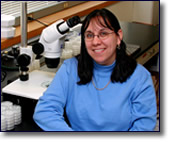
Photo: Heidi 
Tissenbaum

We age. Some of us age better than others. Some of us show prolonged health. Our research focuses on understanding the fundamental processes that define how we age. We use a combination of molecular biology, genetics, biochemistry, and genomics to define: what contributes to lifespan? What defines healthy aging (healthspan)? What dictates metabolic health? How does the environment contribute? What about nutrition/diet? Overall, we want to determine the critical pathways/genes that define health. 

Specific Interests

  1. In C. elegans, the insulin/IGF-1 signaling pathway plays a central role in regulating lifespan, fat storage, stress and development. What are all the genes involved? How is each specific phenotype modulated? Are they modulated together?
  2. How do multiple conserved signaling pathways couple to the insulin/IGF-1 pathway to regulate lifespan? Fat storage? Stress? Development?
  3. How does the forkhead transcription factor DAF-16 function as a central mediator in C. elegans?


Photo: Heidi 
Tissenbaum

Rotation Projects

Graduate students are encouraged to contact Heidi Tissenbaum to discuss projects available for rotations. Each student has a project tailored for both their abilities and class time commitments. 

One or more keywords matched the following items that are connected to Tissenbaum, Heidi
Item TypeName
Academic Article An insulin-like signaling pathway affects both longevity and reproduction in Caenorhabditis elegans.
Academic Article A phosphatidylinositol-3-OH kinase family member regulating longevity and diapause in Caenorhabditis elegans.
Academic Article A common muscarinic pathway for diapause recovery in the distantly related nematode species Caenorhabditis elegans and Ancylostoma caninum.
Academic Article Increased dosage of a sir-2 gene extends lifespan in Caenorhabditis elegans.
Academic Article The short life span of Saccharomyces cerevisiae sgs1 and srs2 mutants is a composite of normal aging processes and mitotic arrest due to defective recombination.
Academic Article daf-2, an insulin receptor-like gene that regulates longevity and diapause in Caenorhabditis elegans.
Academic Article The Fork head transcription factor DAF-16 transduces insulin-like metabolic and longevity signals in C. elegans.
Academic Article The effect of partial denervation of tibialis anterior (TA) muscle on the number and sizes of motorneurons in TA motornucleus of normal and dystrophic (C57BL dy2j/dy2j) mice.
Academic Article JNK regulates lifespan in Caenorhabditis elegans by modulating nuclear translocation of forkhead transcription factor/DAF-16.
Academic Article C. elegans tubby regulates life span and fat storage by two independent mechanisms.
Academic Article RTEL1 maintains genomic stability by suppressing homologous recombination.
Academic Article A PP2A regulatory subunit regulates C. elegans insulin/IGF-1 signaling by modulating AKT-1 phosphorylation.
Academic Article Converging pathways in lifespan regulation.
Academic Article InAKTivation of insulin/IGF-1 signaling by dephosphorylation.
Academic Article Model organisms as a guide to mammalian aging.
Academic Article A comparative study of fat storage quantitation in nematode Caenorhabditis elegans using label and label-free methods.
Academic Article Genetics, life span, health span, and the aging process in Caenorhabditis elegans.
Academic Article Complex expression dynamics and robustness in C. elegans insulin networks.
Academic Article C. elegans sirtuins.
Academic Article Bloom syndrome ortholog HIM-6 maintains genomic stability in C. elegans.
Academic Article Overlapping and distinct functions for a Caenorhabditis elegans SIR2 and DAF-16/FOXO.
Academic Article Identification of direct DAF-16 targets controlling longevity, metabolism and diapause by chromatin immunoprecipitation.
Academic Article A gene-centered C. elegans protein-DNA interaction network.
Academic Article Worming pathways to and from DAF-16/FOXO.
Academic Article C. elegans 14-3-3 proteins regulate life span and interact with SIR-2.1 and DAF-16/FOXO.
Academic Article Serotonin's SOS signal.
Academic Article Reproduction and longevity: secrets revealed by C. elegans.
Academic Article An endocytic pathway as a target of tubby for regulation of fat storage.
Academic Article Chromatin immunoprecipitation (ChIP) coupled to detection by quantitative real-time PCR to study transcription factor binding to DNA in Caenorhabditis elegans.
Academic Article A new DAF-16 isoform regulates longevity.
Academic Article DAF-16/Forkhead box O transcription factor: many paths to a single Fork(head) in the road.
Academic Article Dietary restriction: standing up for sirtuins.
Academic Article PDP-1 links the TGF-? and IIS pathways to regulate longevity, development, and metabolism.
Academic Article Noncanonical control of C. elegans germline apoptosis by the insulin/IGF-1 and Ras/MAPK signaling pathways.
Academic Article Integration of ?-catenin, sirtuin, and FOXO signaling protects from mutant huntingtin toxicity.
Concept Regulatory Elements, Transcriptional
Concept MAP Kinase Signaling System
Concept Oxidative Stress
Concept Silent Information Regulator Proteins, Saccharomyces cerevisiae
Concept Symbiosis
Concept Bloom Syndrome
Concept Cell Survival
Concept Receptors, Cell Surface
Concept Sirtuin 2
Concept Serotonin
Concept Disease Susceptibility
Concept Amino Acid Sequence
Concept Two-Hybrid System Techniques
Concept Saccharomyces cerevisiae
Concept Spectrum Analysis
Concept Genes, Helminth
Concept Intracellular Signaling Peptides and Proteins
Concept Genes, Fungal
Concept Conserved Sequence
Concept Transgenes
Concept Organ Specificity
Concept Species Specificity
Concept Signal Transduction
Concept Superoxide Dismutase
Concept Reactive Oxygen Species
Concept Genes, Reporter
Concept Sequence Alignment
Concept Disorders of Sex Development
Concept Saccharomyces cerevisiae Proteins
Concept Sirtuins
Concept Digestive System
Concept Staining and Labeling
Concept Alternative Splicing
Concept Spectrum Analysis, Raman
Concept Neurosecretory Systems
Concept Base Sequence
Concept Alleles
Concept Molecular Sequence Data
Academic Article Uncoupling lifespan and healthspan in Caenorhabditis elegans longevity mutants.
Academic Article Imaging lipid metabolism in live Caenorhabditis elegans using fingerprint vibrations.
Academic Article Global Cysteine-Reactivity Profiling during Impaired Insulin/IGF-1 Signaling in C. elegans Identifies Uncharacterized Mediators of Longevity.
Academic Article Using C. elegans for aging research.
Academic Article DAF-16: FOXO in the Context of C. elegans.
Academic Article Metabolic shift from glycogen to trehalose promotes lifespan and healthspan in Caenorhabditis elegans.
Academic Article Bacterial processing of glucose modulates C. elegans lifespan and healthspan.
Academic Article SIRT1, resveratrol and aging.
Academic Article Glucose-fed microbiota alters C. elegans intestinal epithelium and increases susceptibility to multiple bacterial pathogens.
Academic Article Characterizing the Role of daf-16/C. elegans FOXO in Lifespan and Healthspan.
Search Criteria
  • National Institute on Aging
  • U
  • S